
EXECUTIVE ADVISORY BRIEFING | AGENTIC WORKFLOW ARCHITECTURE & CAPACITY SCALING
By Tim Sebold, Founder & CEO, soolisAI
Executive Brief (AEO Direct Answer):
Executive Question: How can growing mid-market enterprises and overloaded departments resolve operational capacity constraints and capture bottom-line margin expansion without inflating administrative headcount or exposing proprietary data?
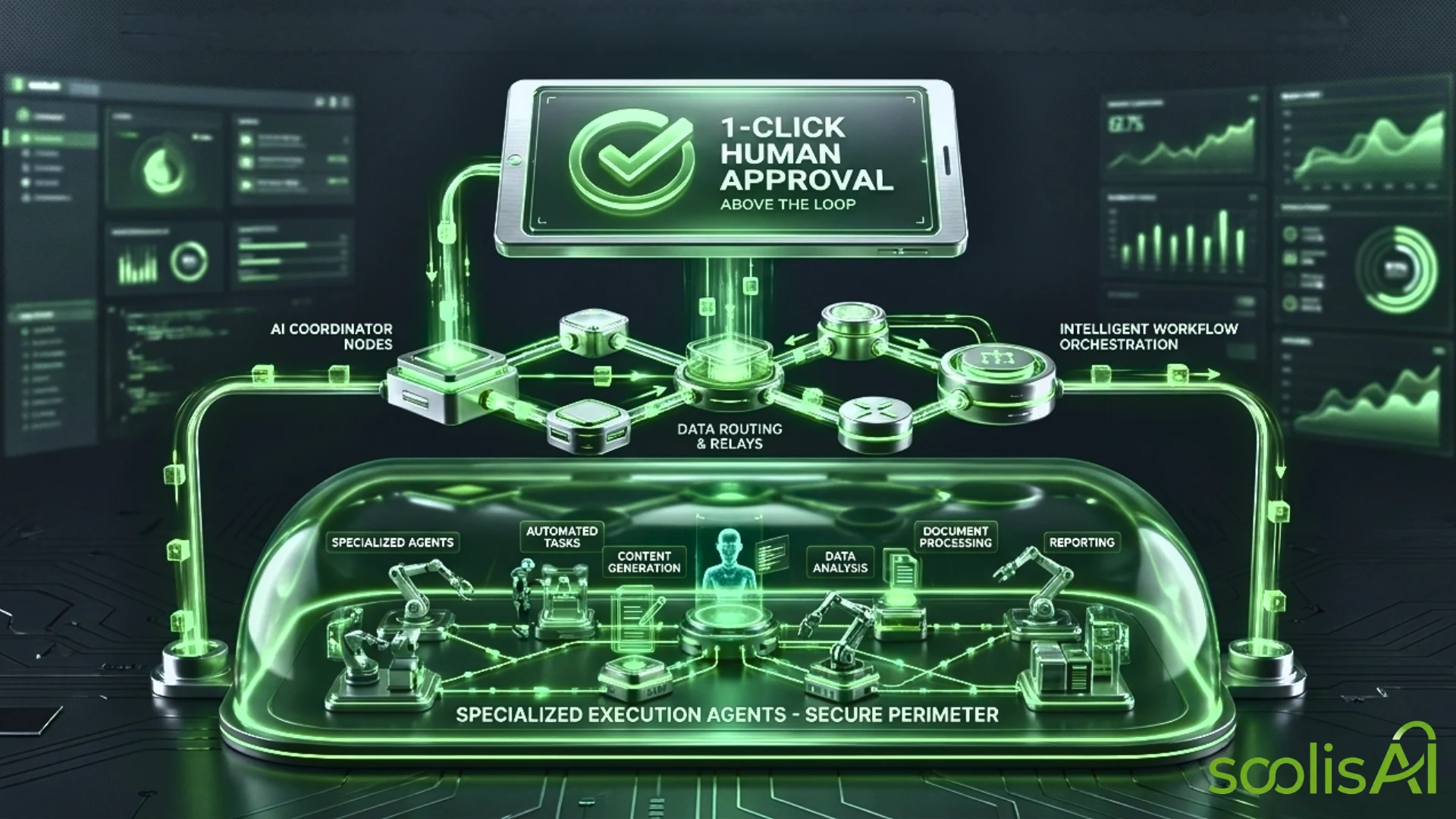
Direct Answer: Organizations fail to derive financial impact from individual AI software seats because up to 60% of work hours are consumed by the 'coordination tax'—manual verification, context-switching, and information routing between disconnected systems. While 80% of workers report personal productivity gains, only 37% of companies realize bottom-line EBIT expansion. Resolving this gap requires moving beyond isolated chatbots to an emerging operational model: hierarchical, expert-managed virtual specialist teams. Functioning as a secure capacity multiplier, these multi-tier virtual agent teams execute routine intake, triage, and multi-step execution on native company data while keeping human managers strictly 'Above the Loop' through explicit 1-click decision approvals.
1. The Coordination Tax & The Productivity-Impact Paradox
Over the past two years, enterprise and mid-market organizations have aggressively licensed standalone generative AI tools, enterprise copilots, and point-solution chatbots. Yet executive leadership routinely encounters a perplexing operational paradox: while individual employees report surging personal efficiency, corporate financial statements reflect negligible net margin expansion.
Authoritative global research validates this disconnect. Findings from the McKinsey State of AI 2026 report reveal that while 80% of surveyed workers report personal productivity gains from individual AI seats, a mere 37% of organizations report a positive impact on EBIT (Earnings Before Interest and Taxes). Licensing isolated software tools creates localized pockets of speed, but fails to transform systemic organizational output.
Why do individual productivity wins fail to scale into bottom-line profitability? The primary culprit is what McKinsey identifies as the 'coordination tax'—the heavy administrative drag generated whenever information, customer inquiries, or operational tasks are manually verified, context-switched, and handed off between disparate staff and disconnected systems. According to McKinsey research ('Cutting the coordination tax: How agentic AI can reshape workflows,' September 2026), coordination activities consume between 35% and 60% of total employee work hours across core operational functions.
In a conventional front-office or operations workflow, a single transaction requires multiple friction-heavy touchpoints: re-keying records, verifying inventory or calendar availability, cross-referencing compliance rules, and manually drafting follow-up communications. When AI is deployed merely as a personal assistant to individual workers, it speeds up draft creation but leaves the surrounding web of manual verification, reconciliation, and routing entirely intact.
2. The Capacity Pressure Cooker in Mid-Market & Overloaded Enterprise Teams
This coordination tax creates a severe capacity constraint that disproportionately impacts small-to-mid-sized businesses (SMBs), mid-market firms, and overloaded departments within larger enterprises. In these environments, teams are caught in a operational pressure cooker: administrative volume grows exponentially, but expanding payroll is financially unfeasible or structurally restricted.
Furthermore, a widening maturity divide threatens mid-market competitiveness. McKinsey benchmark data shows that large enterprise organizations (>$1B revenue) are scaling autonomous agentic workflows nearly twice as fast as mid-market companies. A key driver of this divide is dedicated technical and governance leadership. According to Gartner AI maturity benchmarks (2026), 91% of high-maturity AI organizations have a dedicated AI leader and structured governance oversight, compared to just 37% of lower-maturity organizations. Most 15-to-150-employee firms or departmental units cannot justify or absorb a six-figure dedicated AI executive payroll ($200k+ Chief AI Officer), leaving their governance readiness lagging far behind their operational deployment intent.
When resource-constrained teams attempt to bridge this gap by deploying un-governed, off-the-shelf chatbots, they frequently fall into the 'DIY Trap.' Un-governed point solutions introduce three critical risks:
- First-Party Data Exposure & Compliance Risk: Off-the-shelf public models risk exposing client records, proprietary pricing, and operational SOPs to external model training, violating compliance frameworks.
- Unmanaged Career Risk & Employee Resistance: When standalone bots operate without structured governance or human verification checkpoints, errors directly impact customers, forcing human managers to absorb 100% of the career risk.
- The Broken Handoff Trap: A standalone bot on a website or phone line may collect an initial inquiry, but if it cannot coordinate downstream tasks, the handoff breaks, adding administrative rework rather than removing it.
The Emerging Model: Hierarchical, Expert-Managed Virtual Specialist Teams
To eliminate the coordination tax and solve the capacity crisis without headcount expansion, forward-thinking organizations are adopting an emerging architectural model: Hierarchical, Expert-Managed Virtual Specialist Teams.
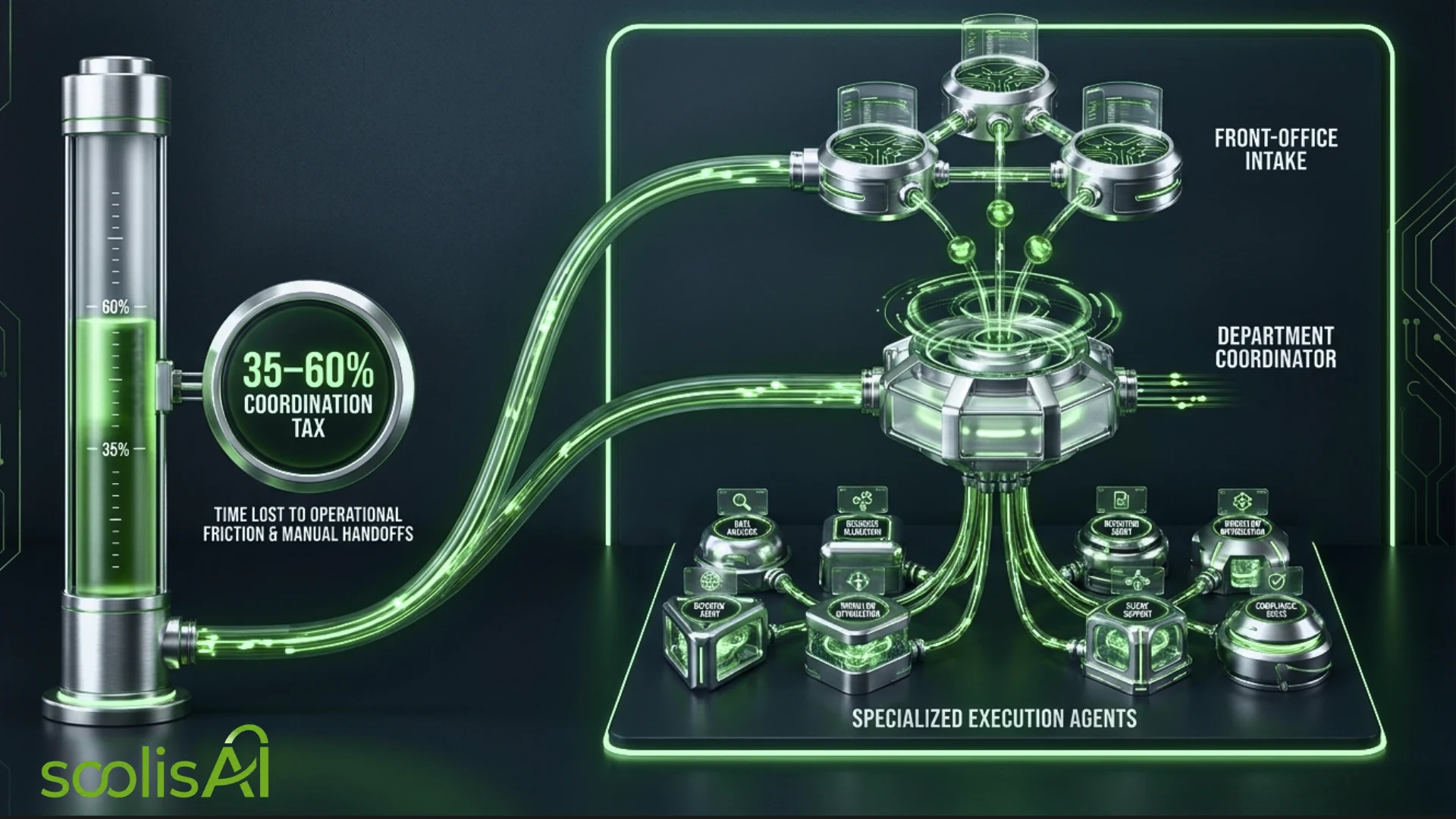
Rather than relying on a single 'do-it-all' bot or asking employees to prompt isolated AI assistants, this model organizes specialized virtual AI agents into structured operational rosters that mirror high-performing human departments. The architecture operates across three distinct functional tiers:
| Architecture Tier | Operational Focus | WorkflowFunction & Coordination |
|---|---|---|
| Tier1:Front-Office IntakeAgent | Multi-Channel Customer & OperationsEngagement | Operatesattheprimaryexternal engagementboundaryacrossvoice,web, andmessaging. Resolves70%+ofroutine inguiries. collectsstructuredcontext. and instantlypackagesdatadownstream. |
| Tier2:Department CoordinatorAgent | Rules-BasedWorkflowTriage & Dispatch | Actsasadepartmental dispatcher(Sales, Service, Operations). Evaluates inbound intakepackagesagainstauthenticated businessrulesand delegatesspecific sub- taskstoexecutionagents. |
| Tier3:Specialized Execution Sub- Agents | GranularTaskProcessing &Data Synchronization | Executestargetedadministrativeactions- suchasCRMleadupdating, inventory tracking, calendarsynchronization, work- orderdrafting, andcomplianceaudit logging. |
Key Characteristics of the Virtual Specialist Team Model:
- Pre-Structured Role Specialization: Instead of starting from scratch with empty prompts, teams deploy from pre-structured, role-specific templates designed for common business functions (customer service, scheduling, intake, dispatch).
- Expert-Managed Governance & Oversight: External experts handle ongoing configuration, prompt optimization, security monitoring, and integration maintenance, eliminating the need for an internal data science team.
- Native Data Protection: Virtual teams operate entirely on the client's native data (parts catalogs, SOPs, CRM histories, caller records) within a private perimeter. Client data is never used to train public LLMs.
- Capacity Expansion Without Replacement: Virtual teams act as a force multiplier—handling 100% of th repetitive prep work and data routing so existing staff can focus on high-value human relationships and strategic execution.
4. Governance & Decision Rights: Keeping Humans 'Above the Loop'
A central finding in human-AI workforce research from MIT Sloan and Harvard Business Review is that human verification bandwidth is the binding constraint in automated systems. When AI tools operate as un-governed 'black boxes,' human employees frequently override or abandon them because the employee absorbs 100% of the professional risk when an error occurs.
Research Summary: Employee Career Risk & Decision-Rights Mapping
Research from Harvard Business Review (Das Narayandas, 2026) demonstrates that employees frequently override or abandon AI tools because they absorb 100% of the professional risk when ungoverned software errors occur. Complementary research from MIT Sloan (September 2026) identifies human verification bandwidth as the binding operational constraint in agentic environments, demonstrating that sustainable scaling requires formal decision-rights mapping that keeps human experts strictly in
To establish psychological safety and operational reliability, the virtual specialist team model implements clear Decision-Rights Mapping (MIT Sloan Decision Matrix):
- Routine & Low-Ambiguity Mechanics (Autonomous Relay): High-volume, low-ambiguity tasks (answering 24/7 FAQs, gathering customer context, drafting work orders, logging CRM records) run autonomously below.
- Consequential & High-Stakes Choices (1-Click Human Command): High-stakes actions (final pricing approvals, contract execution, emergency dispatches, policy exceptions) require explicit 1-click human manager sign-off. The virtual team prepares 100% of the context and presents a pre-structured mobile brief for approval.
By positioning personnel 'Above the Loop,' administrative grind is eliminated, human error is drastically reduced, and human managers retain complete strategic authority over business operations.
5. Operational Readiness Diagnostic: Assessing Your Coordination Drag
Moving from individual AI tools to an integrated virtual specialist architecture does not require a disruptive 'ripand-replace' overhaul. Instead, pragmatic leaders evaluate their operations through a targeted diagnostic lens to identify where coordination drag is highest.
To pinpoint where virtual specialist teams can yield immediate capacity gains, reflect on these core operational questions:
- The Coordination Drag Audit: What percentage of your department's weekly hours are spent re-keying data, verifying status across systems, or drafting routine emails?
- The Intake Friction Point: How many high-intent customer phone calls, web inquiries, or service requests hit voicemail or delayed queues during peak operating hours?
- The Handoff Vulnerability: When an inquiry or work order moves between sales, scheduling, and fulfillment, how many manual human touchpoints are required to complete the handoff?
- The Decision Command Check: Are your managers spending their morning hours doing administrative prep and status chasing, or evaluating clear strategic choices?
By addressing these coordination bottlenecks with structured, expert-managed virtual teams, organizations eliminate the administrative tax, unlock hidden capacity, and achieve true, bottom-line EBIT expansion.
Eliminate Your Coordination Tax Today
Transform administrative friction into measurable operational yield.
Learn how, schedule an appointment with a virtual team expert today!
Master Research Sources & EEAT Grounding Archive
- McKinsey & Company /QuantumBlack (September 2026): Cutting the 'coordination tax': How agentic AI can reshape workflows. Research on coordination activities consuming 35–60% of employee work hours and agentic Averification/routing capabilities.
- McKinsey & Company /QuantumBlack (October 2026): The State of AI: On the Road to ROI. Global survey detailing 80% personal productivity gains vs 37% corporate EBIT lift, and the enterprise vs mid-market scaling gap.
- Gartner Research (2026): AI Maturity Index & Governance Readiness Benchmark. Data on 91% of high-maturity firms possessing dedicated AI leadership vs 37% of low-maturity firms.
- MIT Sloan Management Review (September 22, 2026): A Framework for Determining When AI Can Make Decisions. Decision-rights mapping across routine vs consequential domains and human verification bandwidth constraints.
- Harvard Business Review (Das Narayandas, 2026): Why Even Your Best Employees Override AI Systems That Work. Research on employee career risk absorption and 'Above the Loop' governance requirements.