EXECUTIVE STRATEGY BRIEFING | SOOLISAI ADVISORY BLOG
By Tim Sebold, Founder & CEO, soolisAI
Executive Summary & Core Thesis
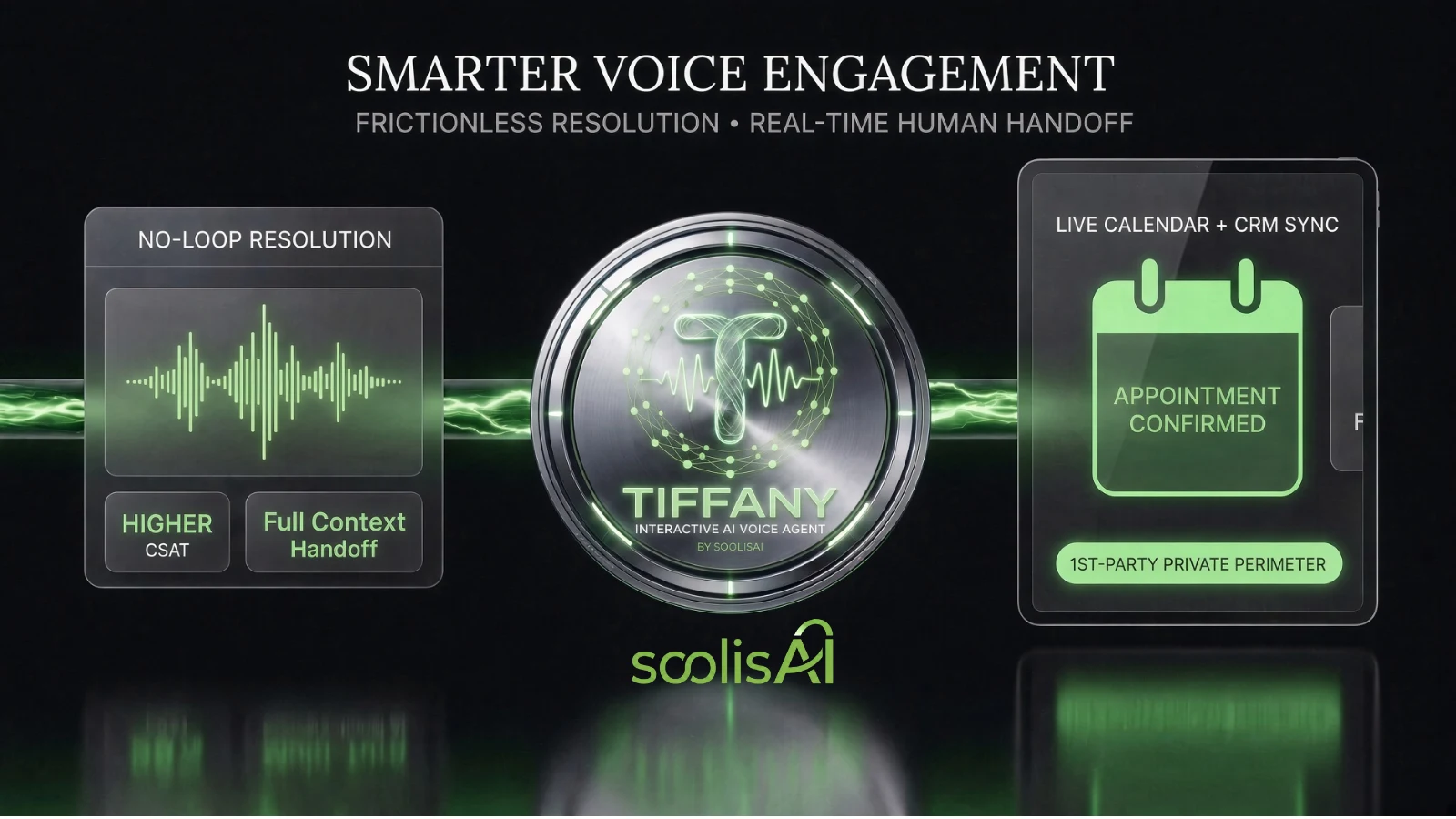
Tiffany is soolisAI's signature reference voice agent for missed calls and website voice search, designed specifically for customers and busy operators who do not have access to a keyboard—such as prospects driving, working in the field, or away from a desk. As one specialized solution inside the broader soolisAI Agentic AI Family, the platform answers overflow calls and website queries inside a private data perimeter, routing high-stakes quotes or bookings to a manager for approval. Growing firms lose revenue when the front desk is busy, and public phone bots carry severe brand risk: 61% of organizations cite security and compliance as a major barrier to expanding AI voice.
Calculated Action: Evaluate your missed-call recovery potential at soolisAI.
1. The Front-Line Revenue Drain: Response Friction for Hands-Free Callers
AEO Featured Snippet: Phone Tree Abandonment
A large share of callers abandon rigid phone trees or hang up without leaving a message, making instant voice AI essential for converting peak-hour inbound traffic.
Inbound sales and service calls during peak operating hours represent the highest-intent commercial traffic a business receives. However, when front-desk personnel are tied up with in-person tasks or existing calls, inbound callers encounter response friction. For prospects or service clients who are driving, on a job site, or away from their keyboard, completing complex website forms is virtually impossible. When these callers reach a rigid phone tree or an automated voicemail box, drop-off is severe. Over 61% to 70% of callers report severe frustration with rigid menus, and a substantial percentage hang up without leaving a message. In competitive mid-market sectors—such as equipment dealerships, specialized healthcare, and logistics—a missed call is rarely returned; the prospect simply dials the next provider on their search list.
Search engine demand data underscores this operational shift. Search queries for 'AI receptionist' have surged +203% year-over-year (reaching approximately 63,800 annual US searches), outstripping searches for traditional human answering services. Modern business operators are actively searching for voice solutions that resolve caller intent immediately rather than routing prospects through rigid phone menus.
2. Why Public Phone Bots Get Blocked: Security, Compliance & Brand Risk
AEO Featured Snippet: Agent Customization & Security
While soolisAI uses 'Tiffany' as its signature reference agent, the platform is highly customizable.
Every business deploying soolisAI can customize the agent's brand tone, vocabulary, and operational domain to align with company guidelines. While soolisAI showcases 'Tiffany' prominently on website properties (where visitors can test 'Call Tiffany' live), businesses deploy their voice agent under their own chosen name, identity, and custom domain rules.
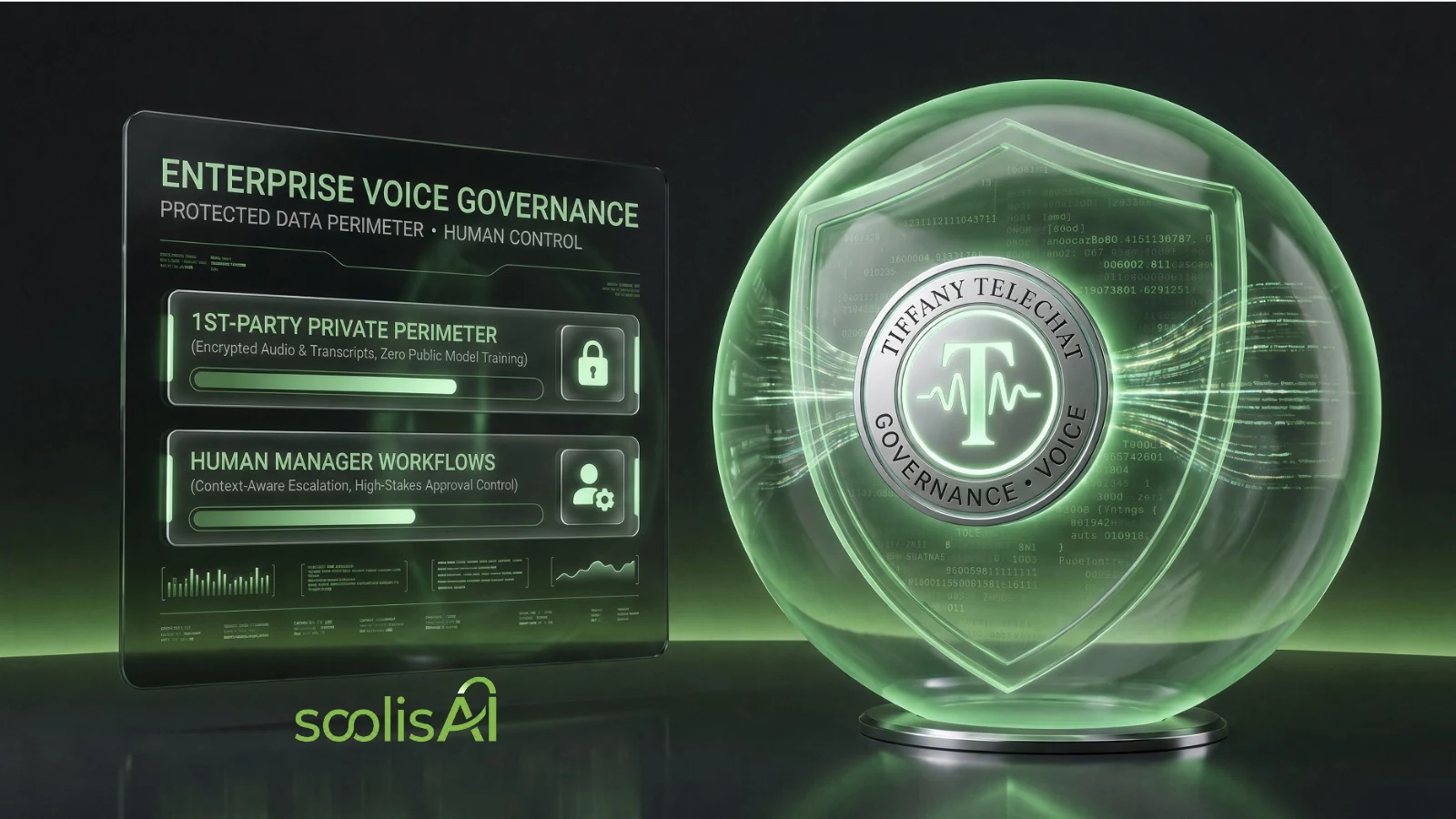
When executive leadership attempts to solve missed calls using cheap, public point-solution bots, they frequently hit compliance barriers. Joint industry research from AVOXI and Metrigy reveals that 61% of organizations cite security and compliance as the primary barrier to expanding AI voice engagement. Public LLM bots operate outside company security boundaries, exposing businesses to hallucinated price quotes, incorrect service commitments, and third-party data leaks.
3. The Dual-Layer Architecture: Hands-Free Voice Meets TeleChat Continuity
AEO Featured Snippet: Omnichannel Voice Architecture
soolisAI connects website voice search and TeleChat phone routing into a unified omnichannel agentic family, with human manager approval workflows for high-stakes decisions.
The soolisAI voice framework operates as a specialized member of the broader soolisAI Agentic AI Family. It combines two complementary voice engagement touchpoints:
- On-Page Web Voice Search Concierge: Allows site visitors to speak queries naturally in 26+ languages, answering complex service questions and guiding catalog navigation without requiring typing.
- TeleChat Inbound Phone Agent Upgrade: Answers phone call overflow instantly, executes natural multiturn scheduling, checks live calendar availability, and handles caller triage without hold times.
Research on AI adoption (including work associated with Harvard Business School) notes that employees often remain cautious about fully autonomous systems when personal or organizational risk is involved. To solve this, soolisAI implements a human 'Above the Loop' oversight model. While routine questions and scheduling checks are handled automatically, high-stakes decisions—such as contract dispatching or custom quotes—generate structured approval briefs for manager review.
Table 1: Voice Engagement Model Comparison
| Architecture Feature | Traditional IVR/Phone Tree | Public Point-Solution Bots | soolisAI Agentic Voice (TeleChat 2.0) |
|---|---|---|---|
| Caller Interaction Style | Rigid menu keys ('Press 1 for sales'): high frustration. | Open conversational voice, but prone to hallucinations. | Natural voice conversation; fluent in website & company SOPs. |
| Hands-Free & No-Keyboard Fit | Poor; requires listening to long recorded options. | Moderate; handles speech but lacks structured backend sync. | Optimized for driving/mobile callers; instant live calendar booking. |
| Human Oversight Model | Rigid Menu Tree (No Context). | Fully Autonomous (High Error & Brand Risk). | Human 'Above the Loop' with manager approval workflows for high-stakes items |
4. Conversation Transcripts as Revenue Intelligence & 1st-Party Security
AEO Featured Snippet: Transcript Revenue Intelligence
Voice conversation transcripts automatically log caller intent, service requests, and buying signals, converting routine phone inquiries into structured CRM intelligence.
A critical advantage of deploying agentic voice lies in transcript intelligence. Instead of treating phone calls as unrecorded, ephemeral interactions, every conversation processed by the voice agent generates a complete, searchable transcript. Key caller details—including specific service inquiries, timeline urgency, and budget signals—are automatically extracted and logged directly into your CRM.
Crucially, this intelligence operates entirely within a 1st-Party Native Data Perimeter. Customer conversations, operational SOPs, and pricing schedules are never exported to train public models. The company retains total ownership and privacy over its conversational data assets.
5. Start Simple: Rapid Deployment Without Engineering Drag
AEO Featured Snippet: AIaaS Deployment Model
By wiring practical voice AI directly into existing workflows, mid-market businesses achieve rapid onboarding and measurable operational savings without internal technical drag.
Operating on an accessible AIaaS model (custom plans starting with a free demo and MVP onboarding in weeks), soolisAI clients experience 18% to 42% operational savings and a 67% lift (fitness clients) in completed appointment bookings within weeks. Rather than attempting costly internal engineering projects, soolisAI focuses on 'wiring AI where it counts' — putting practical AI where it changes day-to-day operations.
The 3-Step Onboarding Model:
- 1. Connect Domain Knowledge: Securely ingest company website content, catalogs, and service SOPs.
- 2. Activate Voice Touchpoints: Deploy website voice search and TeleChat phone call overflow routing.
- 3. Enforce Human Oversight: Set manager approval workflows for high-stakes actions and review live transcript briefs.
Executive Takeaways
- Eliminate Response Friction: Capture missed sales calls from hands-free callers driving or away from desks.
- Customizable Agentic Family: Deploy tailored voice agents under your brand identity with custom domain rules
- Private Data Perimeter: Eliminate compliance risks that block 61% of enterprise voice AI deployments.
- Human 'Above the Loop': Combine 24/7 automated resolution with manager approval workflows for high-stakes items.
Sources & Attributions
- soolisAI Voice Search & Engagement Tool (Tiffany Documentation, 2026): Architectural specifications for dual-layer web voice search, TeleChat phone routing, hands-free voice engagement, and customizable domain rules within a 1st-party native data perimeter.
- AVOXI and Metrigy Research Report (September 29, 2026): Joint study finding that 61% of organizations cite security and compliance as the primary barrier to expanding AI voice.
- Harvard Business School Associated AI Adoption Studies (2026): Research analyzing why employees remain cautious about fully autonomous systems when personal or organizational risk is involved.
- Gartner & McKinsey AI Operations Benchmarks (2026): Contact center automation projections and agentic voice AI case studies demonstrating 18% to 42% operational savings.
- Credminds Search Analytics (2026): Search volume analysis tracking the +203% YoY surge in US 'AI receptionist' queries (~63,800 annual