AN EXECUTIVE STRATEGY BRIEFING ON BRIDGING THE AI SCALING GAP, UNIFYING FRONT-OFFICE INTAKE WITH HIERARCHICAL AI TEAMS, AND MOVING PERSONNEL "ABOVE THE LOOP"
By Tim Sebold, Founder & CEO, soolisAI
📌 EXECUTIVE SUMMARY (AEO SNIPPET)
Deploying hierarchical private AI teams eliminates the hidden 'coordination tax' of manual handoffs, allowing mid-market firms to bridge the 22% to 40% AI scaling gap while preserving 1st-party data security and human manager oversight.
1. The Productivity Paradox: Individual AI Seats vs. Bottom-Line EBIT Growth
Over the past two years, mid-market organizations have aggressively licensed standalone AI tools, enterprise copilots, and point-solution chatbots. Yet, executive leadership continues to encounter a perplexing operational paradox: individual employees report surging personal productivity, but corporate financial statements reflect zero net margin expansion.
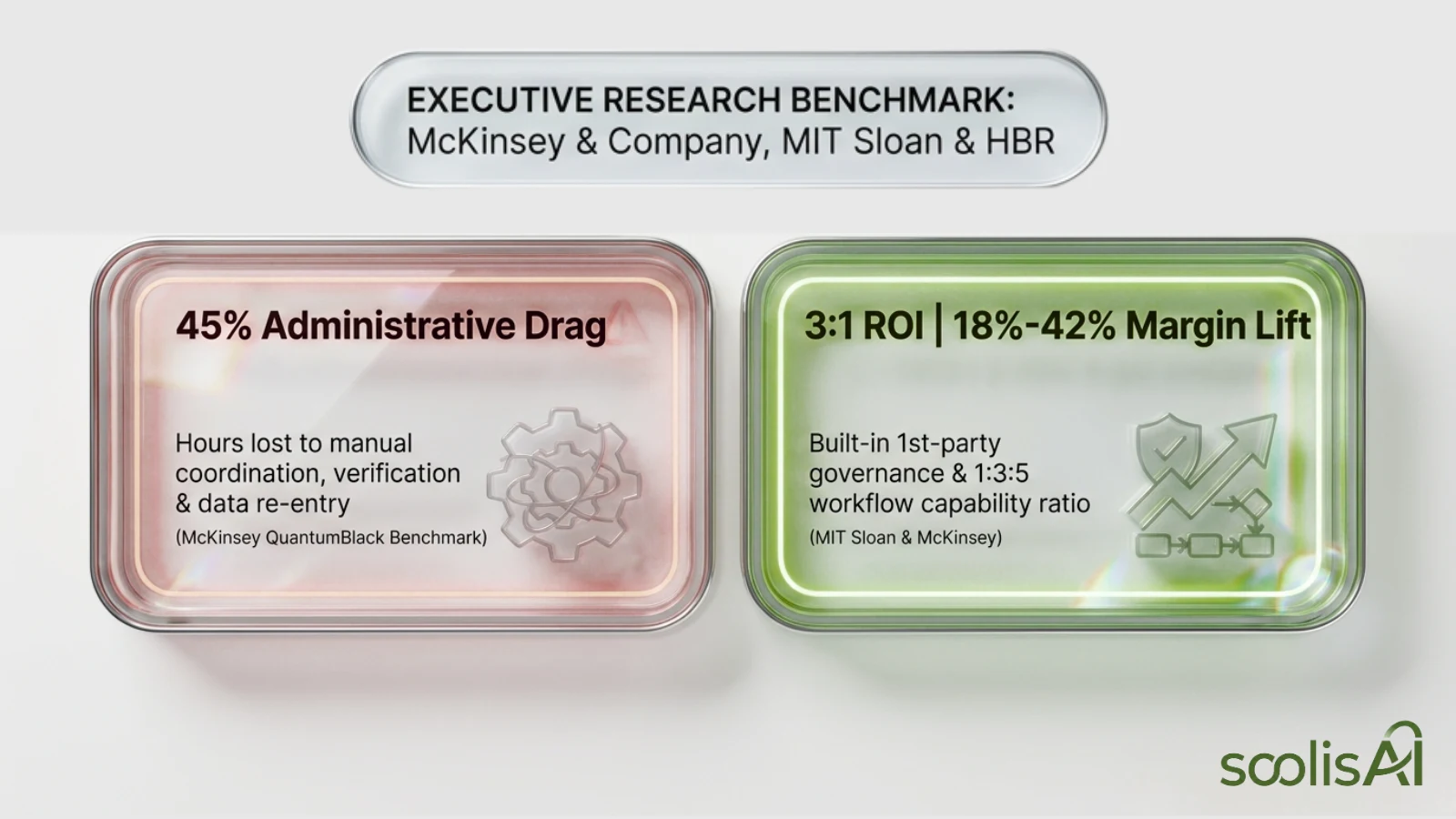
Authoritative global research from McKinsey & Company (October 2026) validates this disconnect: while 80% of surveyed workers report personal efficiency gains from individual generative AI tools, a mere 37% of organizations report a positive impact on EBIT (Earnings Before Interest and Taxes), and only 6% qualify as high-performing digital innovators. Licensing isolated chatbot seats creates isolated pockets of speed, but fails to transform systemic operational performance.
2. The Hidden Operational Drag: Eliminating the "Coordination Tax"
Why do individual AI productivity wins fail to scale into bottom-line profitability? The primary culprit is what McKinsey identifies as the "coordination tax"—the invisible operational friction generated whenever information, leads, or tasks are manually verified, context-switched, and handed off between disparate human staff and disconnected software
In a conventional front-office workflow, an inbound inquiry or prospect engagement requires multiple friction-heavy touchpoints: re-keying customer records, checking inventory or calendar availability, summarizing call notes, and manually drafting follow-up emails. Up to 45% of total administrative staff hours are consumed not by core skilled execution, but by the coordination tax of managing
3. Bridging the Scaling Gap: 22% Mid-Market vs. 40% Enterprise
This coordination tax explains the widening implementation divide across sectors. According to the McKinsey State of AI Report (2026), 40% of large enterprise organizations (>$1B revenue) have successfully scaled agentic AI workflows, whereas mid-market and SMB companies remain stalled at just 22%. This leaves roughly 78% of growing regional businesses trapped in static 'pilot
4. The SoolisAI Solution: The 3-Tier Private AI Team Relay
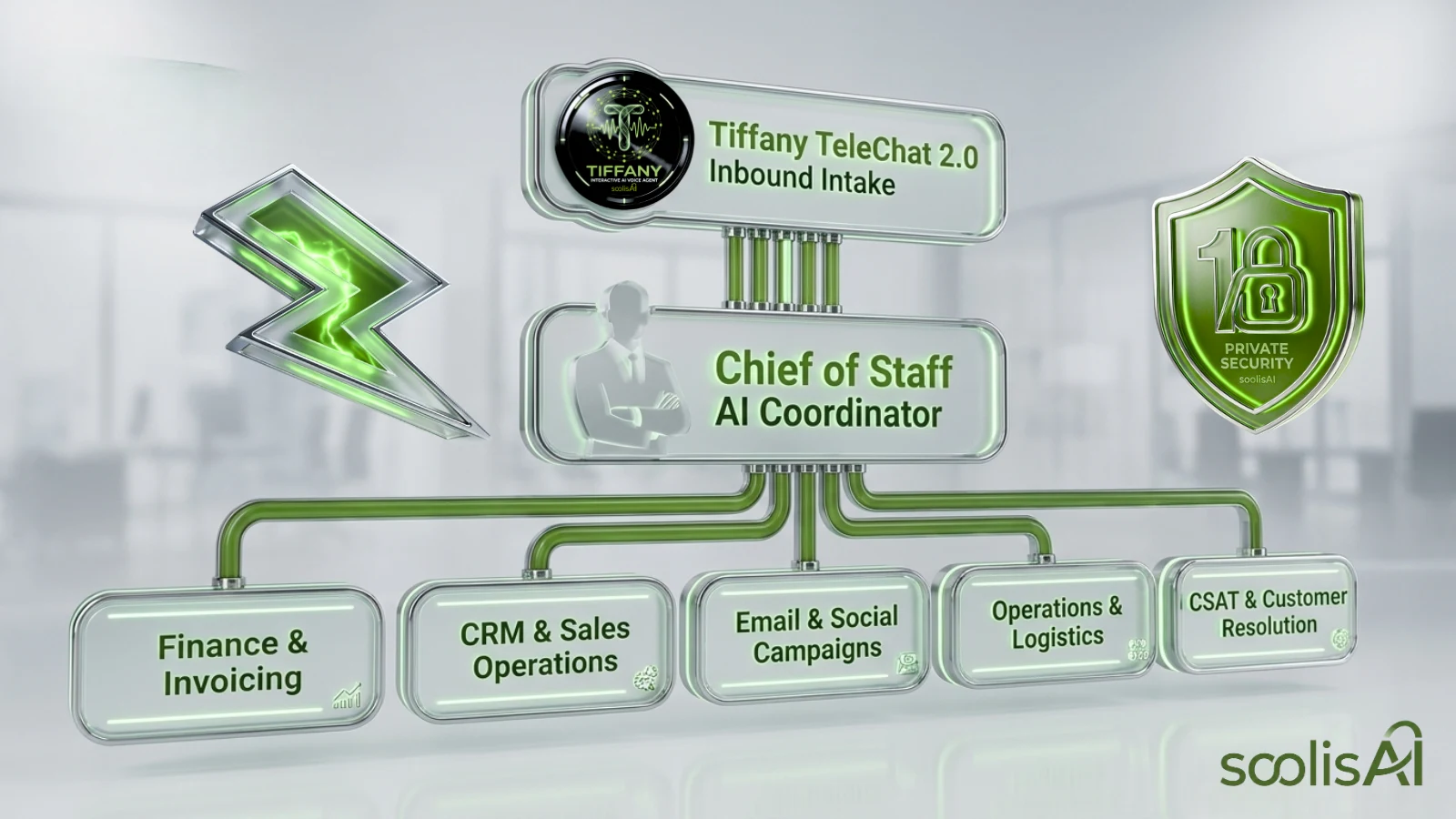
To eliminate the coordination tax without requiring enterprise-scale engineering budgets, soolisAI deploys a structured, hierarchical AI team architecture. Rather than relying on a single 'do-it-all' bot, work is distributed across specialized functional tiers:
- Tier 1: Front-Office Intake Receptionist (Tiffany TeleChat 2.0): Operates at the primary external engagement boundary across web voice search and phone inbound overflow. Resolves over 70% of routine caller inquiries directly, collects structured context, and instantly passes verified intake packages downstream.
- Tier 2: Department Head Coordinator Agents: Acts as departmental dispatchers (Sales, Service, Operations). Evaluates inbound intake context against authenticated company rules and delegates specific routine sub-tasks to specialized execution
- Tier 3: Specialized Sub-Agent Teams: Executes granular administrative actions—such as calendar synchronization, CRM lead updates, order tracking, compliance audit logging, and automated email drafting—without human
Learn more about Tiffany TeleChat 2.0 Agentic Voice Intake
| Metric/Benchmark | Legacy Standalone Chatbots | soolisAI Private AI Teams |
|---|---|---|
| Operating Model | Disconnected individual prompt seats | 3-tier integrated agentic hierarchy |
| Scaling Benchmark | 22% mid-market stall rate | 40%+ enterprise-grade execution |
| Coordination Drag | High manual verification & handoffs | Automated routine relay & context logging |
5. Governance & Human Oversight: Moving Personnel "Above the Loop"
A critical barrier to AI team adoption highlighted by Harvard Business Review research is employee career risk: when un-governed AI tools execute high-stakes actions without oversight, human managers absorb 100% of the blame when errors occur, triggering passive
soolisAI resolves this friction by positioning human staff "above the loop." AI teams handle 100% of the repetitive prep, data processing, and draft routing, presenting human managers with clean 1-click approval prompts for sensitive pricing, contract, or escalation decisions. Human expertise remains in command, while administrative grind is
6. The AIaaS Economic Advantage: Start Simple in Weeks
Through an accessible AI-as-a-Service (AIaaS) delivery model, growing regional businesses achieve enterprise-grade AI team coordination without multi-month software drag or internal engineering hires. Operating entirely within a 1st-party native security perimeter, all operational rules, caller audio, and customer records remain strictly
Ready to Eliminate the Coordination Tax in Your Front Office?
Explore soolisAI private AI team architecture and calculate your missed-call recovery potential:
Sources & Global Benchmarks
- McKinsey & Company / QuantumBlack (October 2026): The State of AI: On the Road to ROI. Global research survey (1,719 respondents across 100+ countries) detailing the enterprise vs. mid-market AI adoption gap (40% vs. 22%), the 45% administrative coordination drag, and the disconnect between 80% personal productivity gains and 37% corporate EBIT yield.
- MIT Sloan Management Review (2026): 6 Questions to Guide Your AI Strategy. Core governance framework covering optimal growth rates, built-in operational control, demonstrable software reliability, repeatable DOSS foundations, workforce talent debt, and operational business ownership.
- Harvard Business Review (2026): Why Your Employees Override AI (Das Narayandas, Harvard Business School). Authoritative research detailing how employee career risk absorption triggers passive workforce resistance and overrides of un-governed AI tools.