AN EXECUTIVE STRATEGY BRIEFING ON THE RISKS OF DIY POINT-TOOLS, UN-GOVERNED SHADOW AI, AND THE POWER OF TURN-KEY PROTECTED AIaaS
By Tim Sebold, Founder & CEO, soolisAI
📌 Executive Summary (AEO Answer Snippet):
Two-thirds of small and mid-sized businesses building custom AI tools encounter governance gaps and shadow AI risks; deploying private, 1st-party governed AI teams with 1-click human approvals eliminates liability while automating routine workflows. soolisAI's experts handle the architecture and ongoing operation, so your team does not need to build or maintain the bot hierarchy itself.
1. The DIY Illusion: Why 66% of Small Business AI Projects Fail to Scale
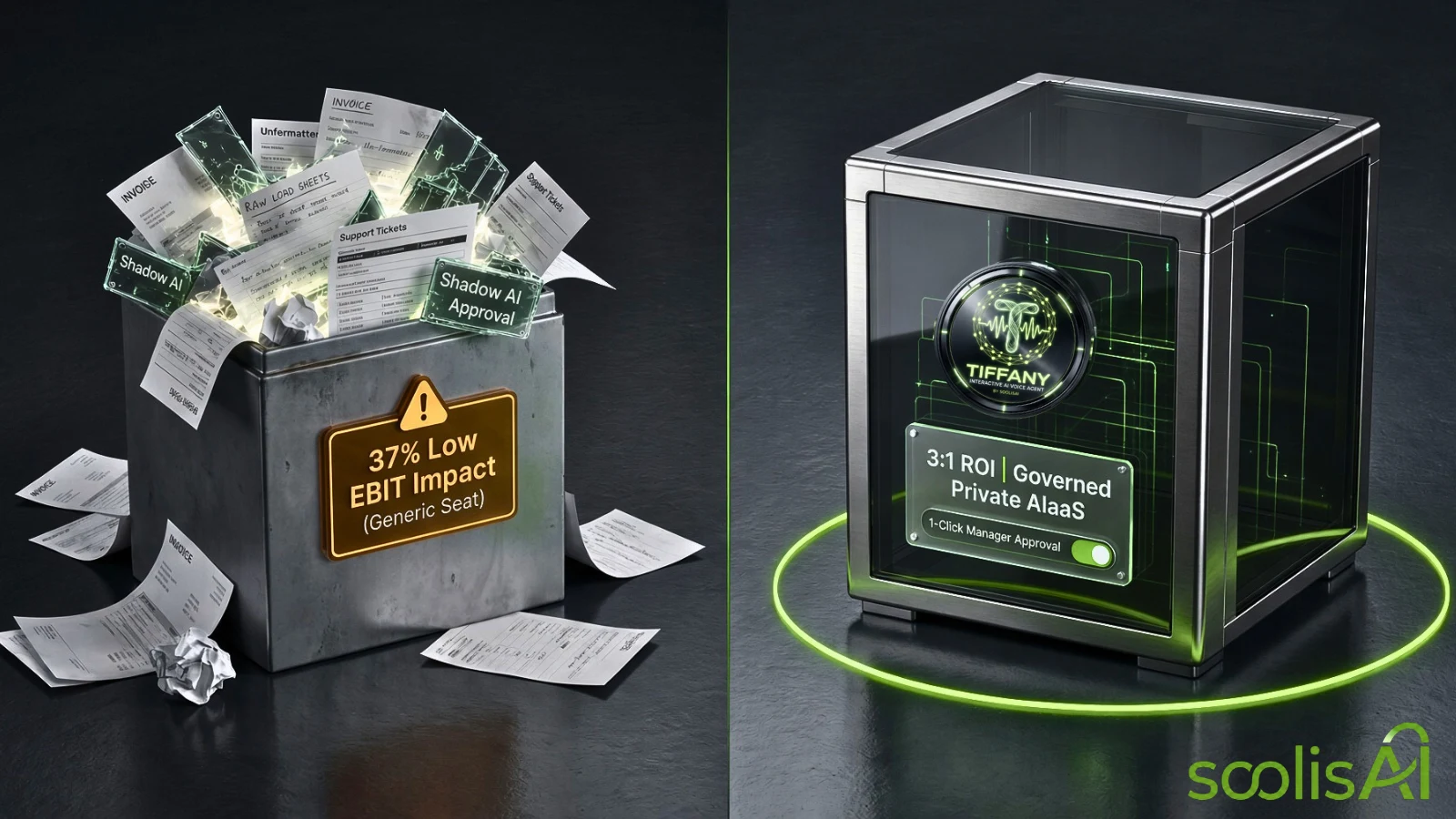
Across the small and mid-sized business (SMB) landscape, executive leaders and founders are actively seeking ways to automate administrative overhead without expanding payroll. According to recent Pax8 SMB research (October 2026), two-thirds (66%) of AI-using small and mid-sized firms have built at least one custom AI tool or automated workflow now in regular use.
However, building an initial AI prototype is vastly different from deploying a governed, enterprise-grade system. Pax8 data reveals that governance has failed to keep pace with building, leading to discovered "shadow AI" in roughly 35% of surveyed businesses. Small business owners buy individual AI prompt seats or attempt "DIY bot building" using public automation connectors, only to hit a wall when those bots hallucinate pricing, drop customer leads, or expose private client data to public LLM training sets.
2. The 5-to-15 Employee Pressure Cooker: The Wearer of Many Hats
In an organization with 5 to 15 employees—such as a regional equipment dealership, specialized healthcare clinic, or logistics brokerage—staff members rarely have singular job descriptions. Key team members wear three or four operational hats daily, balancing customer intake, scheduling, inventory tracking, and
Recent OECD research on SME digital transformation (October 2026) highlights that smaller enterprises are urgently redesigning front-office operations around AI agents for customer service, compliance, and supply chain tracking precisely because they lack dedicated internal IT or engineering departments. When a 10-person firm relies on fragmented, un-governed DIY bots, administrative chaos multiplies rather than
3. The Three Critical Pitfalls of Un-Governed DIY Bots
Pitfall 1: Data Leaks & Compliance Exposure (35% Shadow AI Risk): Off-the-shelf public chatbots and unencrypted web tools transmit proprietary pricing lists, customer contact info, and patient records outside the company wall—violating strict privacy standards and exposing the firm to severe brand
Pitfall 2: Middle Manager Career Risk & Adoption Stalls: As Harvard Business Review research ("Middle Managers Will Make or Break AI Adoption") demonstrates, workers actively override or abandon autonomous AI tools when they absorb 100% of the personal career risk for bot errors. Without human manager oversight built into the software, staff quietly refuse to use
Pitfall 3: The Broken Handoff Trap: A DIY bot sitting on a website might capture an email address, but fails to route structured context downstream to calendar systems or department heads—forcing human staff to re-verify every detail
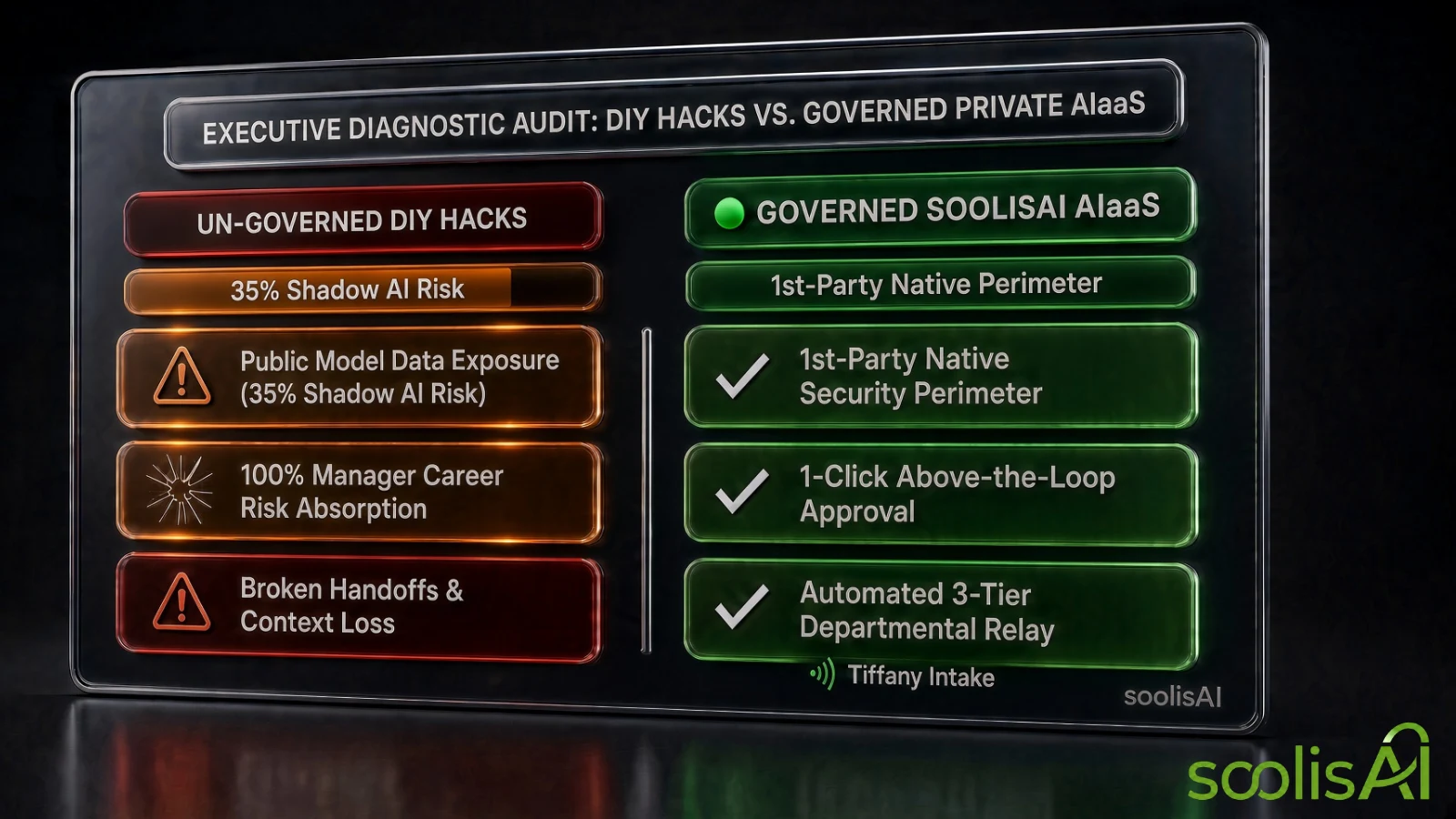
| Evaluation Metric | DIY Custom Bot Hacks | soolisAI Governed AI Teams |
|---|---|---|
| Security & Perimeter | High Shadow AI risk (35%); public LLM data leaks | 1st-party native security perimeter; 100% private |
| Manager Governance | Zero oversight; human absorbs 100% career risk | 1-click human manager approval workflows ("Above the Loop") |
| Workflow Architecture | Single point failure; manual copy-paste handoffs | 3-tier relay (Tiffany Intake → Dept Head → Sub-Agents) |
4. The soolisAI Governed Solution: Tiffany Intake + Mini-Bot Teams
soolisAI replaces high-risk DIY bot hacks with a turn-key, governed operating model designed specifically for growing mid-market and SMB organizations. The workflow creates a seamless, protected relay:
- 1. Tiffany TeleChat 2.0 Agentic Voice Intake: Acts as the universal front-office receptionist across phone overflow and web voice search. Resolves routine caller inquiries instantly and collects structured interaction briefs.
- 2. Department Head Coordinator Agents: Receives Tiffany's structured intake package and automatically dispatches routine execution to specialized mini-bot teams (Sales Nurture, Service Scheduling, Inventory Sync).
- 3. 1-Click Human Manager Approval: Before any sensitive quote is sent or appointment confirmed, the system presents the human owner or office manager with a simple mobile approval prompt. The manager stays in command without doing the administrative legwork.
Unlike fragmented DIY experiments or ungoverned multi-bot setups, soolisAI's experts design, deploy, and operate the complete governed hierarchy—Tiffany at intake, Department Head Coordinators, and specialized sub-agent teams—inside your 1st-party native data perimeter, with 1-click human approvals and continuous expert support.
5. Start Simple: Enterprise Leverage on an SMB AIaaS Budget
By subscribing to soolisAI's AI-as-a-Service (AIaaS) platform, 5-to-15 person businesses gain the operational capacity of a 50-person enterprise. soolisAI's experts handle the architecture and ongoing operation, so your team does not need to build or maintain the bot hierarchy itself. Your team operates within a 1st-party native security perimeter—protecting customer data, eliminating shadow AI risks, and achieving measurable margin expansion in weeks rather than months.
🧮 Ready to Replace Un-Governed DIY Bot Hacks with Protected AI Teams?
Calculate your operational yield and schedule an executive consultation today:
Sources & Global Benchmarks
- Pax8 SMB Research (October 2026): Small and Mid-Sized Business AI Adoption Benchmark. Report detailing that 66% of AI-using small and mid-sized businesses have built custom AI tools or automated workflows, with 35% encountering discovered shadow AI risks and compliance
- OECD SME Digital Transformation Report (October 2026): Redesigning SME Front-Office Operations Around AI Agents. Global benchmark data on small enterprise (5–15 employees) capacity constraints, multi-hat operational pressure, and agentic workflow
- Harvard Business Review (2026): Why Even Your Best Employees Override AI Systems That Work (Das Narayandas, Harvard Business School). Research on middle manager career risk absorption, governance timing, broken handoffs, and workforce trust in automated