OPERATIONAL STRATEGY & AI GOVERNANCE FOR SMBs AND LOWER MID-MARKET LEADERS
By Tim Sebold, Founder & CEO, soolisAI. An applied reading of MIT Sloan's 2026 work on agent decision rights and human oversight, mapped to Administrative Bot Teams for SMBs.
AEO Executive Answer Block
Core Question: How can small businesses and small-to-mid-market leaders deploy AI agents to eliminate administrative clutter without introducing operational risk or losing oversight?
Executive Summary: For SMBs and growing regional operations, scaling AI safely requires moving away from individual chatbot seat licenses toward structured Administrative Bot Teams. Selling AI as autonomous "digital coworkers" creates a dangerous accountability gap because when an un-governed tool makes an error, the human employee absorbs the personal career risk. By deploying specialized agent teams (Coordinators + Specialists) that handle manual triage and brief preparation while keeping human managers strictly "above the loop" with 1-click approval authority, small-to-midsize businesses eliminate daily inbox clutter, capture buried revenue opportunities, and protect their brand—all within a private, 1st-party native data perimeter with zero added technical
Learn how soolisAI builds protected Bot Teams for growing businesses
1. The Front-Line SMB Reality: Drowning in Clutter, Missing Revenue
For owners, General Managers, and operations leaders running agile businesses—from regional equipment dealers and franchise groups to commercial logistics hubs—the biggest drag on growth is rarely a lack of market opportunity. It is administrative clutter.
Small and mid-sized teams spend up to a third of their workweek acting as human routers: wading through inbox noise, manually triaging customer inquiries, updating records, and chasing schedule confirmations. When high-value staff are buried in routine administrative drag, two costly breakdowns occur:
- High-Cost Operational Drag: Experienced personnel burn expensive hours on low-value sorting instead of high-value execution.
- Lost Revenue Opportunities: High-intent sales inquiries, service requests, and upsell leads get buried in the noise or answered too
Trying to solve this by handing out generic chatbot seat licenses only adds to the chaos. When every employee invents their own prompts in an unmonitored silo, business intelligence gets scattered, brand consistency vanishes, and confidential customer data leaks into public
2. Why Employees Override AI: The Career Risk Factor
Most enterprise software vendors promise that AI "agents" will act as autonomous coworkers. But when these tools fail in the real world, leaders are left wondering why their team quietly stops using them or overrides their
Recent industry research reveals the underlying cause: employees override working AI tools not because the software is weak, but because the human employee absorbs 100% of the career risk when the tool makes a mistake (Harvard Business Review, 2026).
According to McKinsey's global AI research, while 40% of large enterprise organizations (>$1B) have successfully scaled AI agents, smaller and mid-market organizations remain stuck at just 22%. Smaller businesses cannot afford $100,000 multi-agent experiments, nor can they risk an ungoverned bot sending an incorrect quote or damaging a client relationship.
To bridge this gap, businesses do not need more chatbot seats. They need a governance model that separates execution from accountability.
3. The Blueprint: Deploying Bot Teams with Human Approval Authority
Autonomy should remove busywork, not human accountability. AI agents should be granted strict execution permissions, but human managers must retain approval authority, override controls, and full audit visibility.
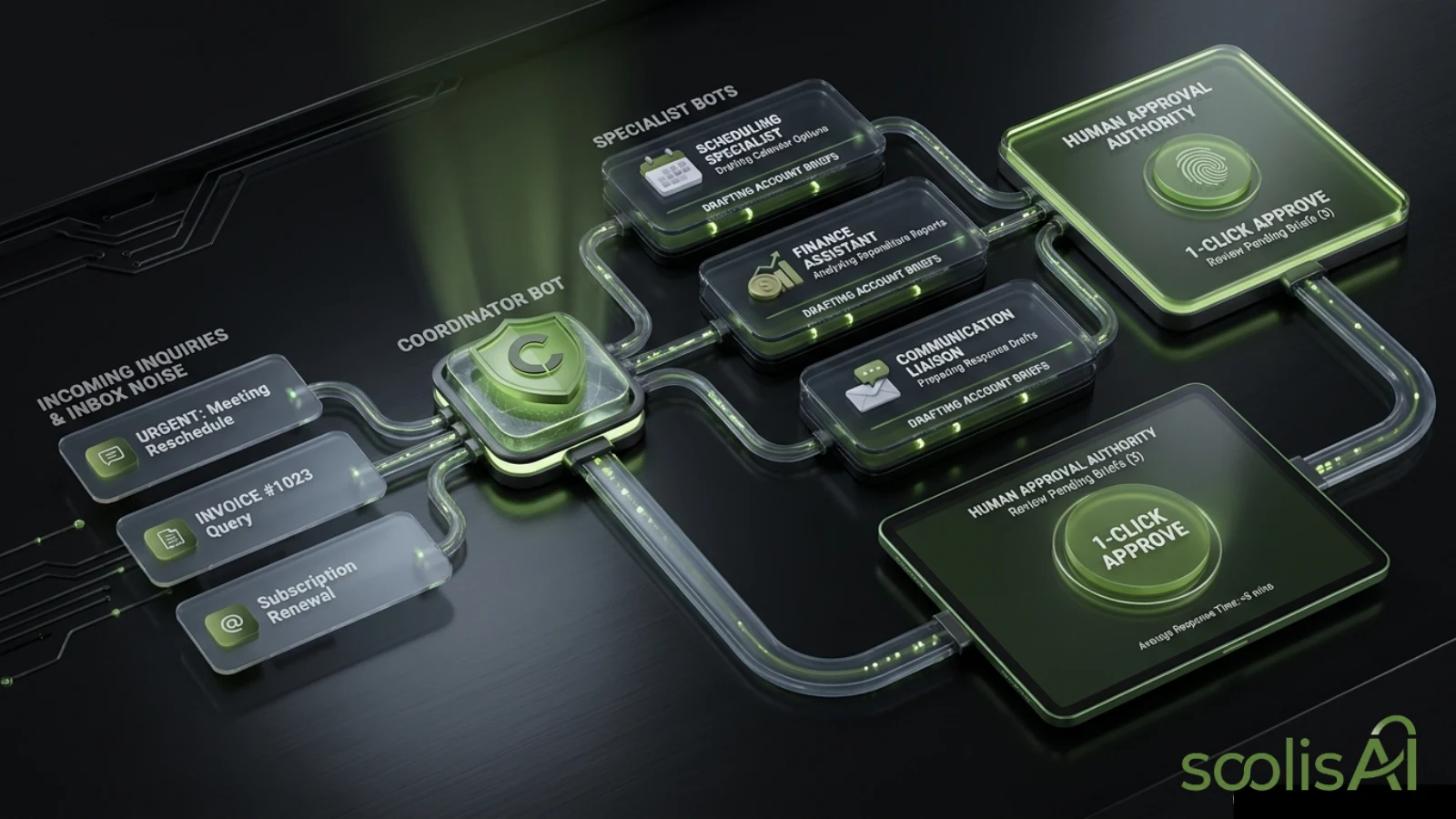
Instead of isolated software seats, forward-thinking leaders deploy structured Administrative Bot Teams tailored to specific operational workflows:
- The Coordinator Bot: Acts as the primary operational filter. It continuously monitors incoming communications, categorizes priority, removes spam and clutter, and routes actionable items.
- Specialist Bots: Focused agents that execute specific sub-tasks—compiling client account histories, pulling inventory status, drafting tailored email responses, and generating morning execution briefs.
- The Human Manager: Elevated "above the loop." Instead of manually typing every response from scratch, the manager simply reviews pre-drafted briefs and approves, edits, or overrides them with a single click.
Explore live Administrative Bot Team workflows
4. Powered by High-Performance Engine Runtimes, Secured by Private Data
To deliver lightning-fast response speeds without sacrificing accuracy, modern bot teams utilize advanced runtime engines like Grok Bots. However, deploying raw commercial models directly into a business exposes proprietary data to public training sets.
This is where soolisAI transforms raw AI power into a secure business asset:
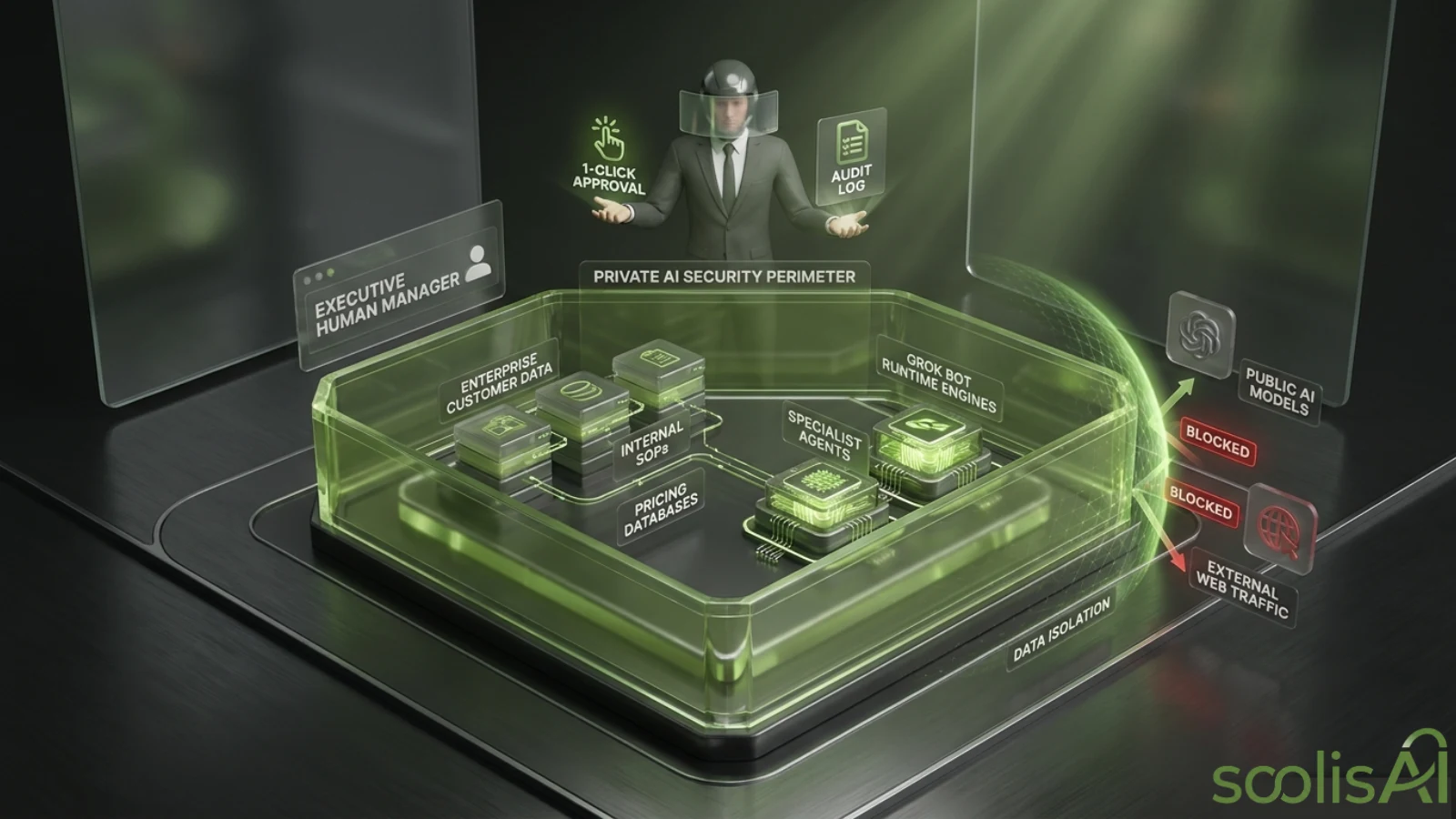
- 1st-Party Native Data Perimeter: All bot operations run 100% within your brand's private data boundary. Your customer records, pricing schedules, and internal SOPs never leak to public models.
- Brand-Aligned Guardrails: Bot teams are fine-tuned strictly on your approved brand voice, terminology, and operating rules.
- Closed-Loop Audit Trail: Every action, draft, and approval is logged in a transparent audit trail, giving leadership complete operational visibility.
5. The "Start Simple" Entry Point: Transforming Daily Operations
You do not need to hire expensive internal data scientists or overhaul your entire IT infrastructure to capture real AI yield. By taking a "Start Simple. Scale Where It Counts" approach, SMBs begin with immediate, high-yield wedges:
- Email & Triage Automation: Eliminate 80% of daily inbox noise while ensuring high-intent sales inquiries receive immediate, personalized attention.
- Account Briefing & Lead Capture: Automatically synthesize customer history before phone calls so your team walks into every meeting fully prepared.
- Protected AI as a Service (AIaaS): Gain an embedded, strategic partner to configure, maintain, and monitor your bot teams with zero added technical headcount or payroll drag
Stop buying generic point-solution software. Start driving measurable operational yield with protected, human-led Bot Teams.
Calculate your operational return and book a private consultation
Executive Takeaways
- Avoid the "Coworker" Trap: AI agents are execution tools, not independent employees. Keep your human team accountable by giving them final approval authority over agent outputs.
- Fix the Administrative Drag First: The fastest entry point for SMB ROI is automating inbox clutter, lead triage, and account brief preparation.
- Protect Your Proprietary Intelligence: Ensure your AI operates inside a closed-loop, 1st-party native data perimeter to protect company data and customer trust.
Sources
- Harvard Business Review (2026): Why Your Employees Override AI (Das Narayandas, HBS). Research highlighting why employees override un-governed AI tools due to unaddressed personal career risk.
- McKinsey & Company / QuantumBlack (2026): The State of AI: On the Road to ROI. Global survey detailing the adoption gap between enterprise organizations (40% scaling agents) and midmarket/SMB firms (22% scaling agents).
- MIT Sloan September 22, 2026: "A framework for determining when AI can make decisions" (Beth Stackpole; research by Ina Sebastian, Peter Weill, Thomas Haskamp, and Jan vom Brocke). Human oversight remains in place across decision types; deployed agents need a named human owner.
- xAI Product & Architecture Documentation: Introducing Grok Bot & Team Bots—frameworks for specialist agent orchestration and support scaling.