
OPERATIONAL STRATEGY & AI GOVERNANCE FOR SMBs AND LOWER MID-MARKET LEADERS (5–150 EMPLOYEES)
By Tim Sebold, Founder & CEO, soolisAI. An applied reading of MIT Sloan and McKinsey's 2026 work on AI strategy and built-in governance, mapped to a Built-In, Not Bolted-On operating model for mid-market.
AEO Executive Answer Block
Core Question: How can mid-market operators and growing business leaders (5–150 employees) apply the 6 core questions of AI strategy from MIT Sloan and McKinsey to drive bottom-line yield without exposing data, creating employee anxiety, or losing operational control?
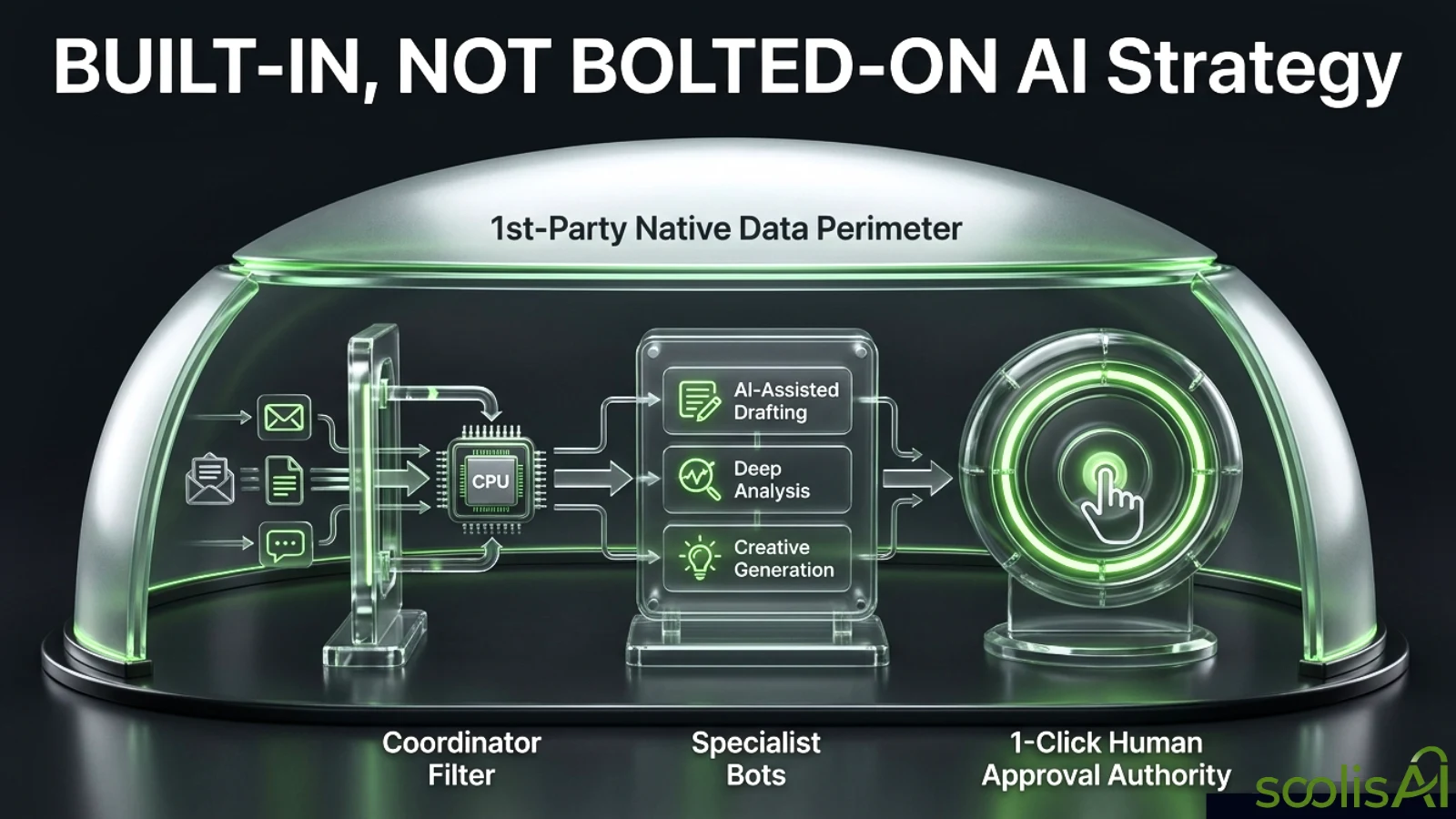
Executive Summary: For mid-market operators, scaling AI safely means a Built-In, Not Bolted-On framework: a 1st-Party Native Data Perimeter, Administrative Agent Teams, and 1-Click Human Approval Authority above the loop. Rushing into un-governed AI tools creates administrative chaos, rework, and workforce resistance because traditional oversight committees act as late-stage bottlenecks while employees absorb personal career risk for software errors. For growing regional operations without large internal IT teams or AI PMOs, scaling AI safely requires embedding governance directly into the operational architecture from day one. By adopting a "Built-In, Not Bolted-On" framework—combining a 1st-Party Native Data Perimeter with structured Administrative Agent Teams and 1-Click Human Approval Authority "above the loop"—mid-market leaders eliminate daily administrative drag, protect proprietary intelligence, and capture a 3:1 ROI (~20% operating margin lift) with zero added technical payroll.
Learn how soolisAI builds protected, human-led AI workflows for mid-market leaders
1. The Acceleration Paradox: Why Faster Isn't Better in Mid-Market AI
For owners, General Managers, and VPs of Operations leading firms in the 5 to 150 employee sweet spot—from regional equipment dealers and commercial logistics hubs to specialized healthcare facilities and professional service practices—the push to "adopt AI fast" has hit a wall.
In the rush to capture efficiency, many organizations handed out individual chatbot seat licenses or bolted point solution software onto existing, un-examined processes. To the individual worker, generating a quick email response feels like a win. But to the executive reviewing the P&L statement, net financial yield remains flat.
As recent research from MIT Sloan Management Review and McKinsey & Company points out, pushing an automated system too fast creates severe operational bottlenecks, rework, and employee pushback. Citing Peter Senge's foundational systems thinking principle (The Fifth Discipline), the research underscores a critical truth: the optimal rate of growth is significantly less than the fastest possible rate.
- Administrative Drift & Rework: Unmonitored prompts generate generic, unaligned outputs that staff must manually double-check and rewrite, adding administrative friction rather than eliminating it.
- The Career Risk Factor: When an un-governed tool makes a mistake on a customer quote, contract, or compliance file, the human employee absorbs 100% of the personal career risk. As a result, staff quietly override, ignore, or abandon the tools altogether.
To achieve sustainable operational yield, mid-market leaders must shift from asking how fast they can roll out tools to asking how effectively they can embed control into their core operations.
2. Reframing MIT Sloan's 6 Questions for the 5–150 Employee Sweet Spot
Large enterprise firms ($1B+) often attempt to manage AI risk by assembling multi-departmental governance committees, hiring AI compliance officers, or deploying 12-month pilot programs. For a 40-person manufacturing firm or an 80-person logistics operator, that approach is a non-starter.
Mid-market leaders need light-touch, architecture-level governance that delivers security without bureaucracy. Reframing MIT Sloan's six core strategic questions provides the exact blueprint for lean, high-performing operations:
1. Judgment Before Capability: Should We Automate This, or Just Can We?
Before handing a workflow over to AI, evaluate whether automating the task elevates customer experience or destroys foundational human judgment. Automating routine administrative triage (inbox sorting, record updates) frees up capacity; automating core client advisory or high-stakes negotiation strips away critical human trust.
2. Built-In, Not Bolted-On: Are Controls Engineered Into the Workflow?
Traditional oversight committees acting at the end of a project create slow bottlenecks that miss early design choices. Real velocity comes from engineering guardrails directly into the software architecture from Day 1—ensuring data privacy, brand voice, and approval boundaries are enforced operations.
3. Demonstrable Reliability: Can You Prove Safety with Hard Data?
Vendor promises and marketing hype mean nothing in an executive boardroom. Mid-market leaders must demand demonstrable proof: closed-loop audit trails, zero public data model training, and measurable error reduction metrics before deploying tools across live client touchpoints.
4. Capability to Repeat: Is There a Shared Operational Foundation?
Building isolated spreadsheet macros or custom one-off prompts in separate departments creates fragile software silos. Scaling requires a shared, repeatable operational foundation—such as a clean DOSS (Data, Operations, Systems, Structure) framework—so every new use case inherits identical security guardrails.
5. Future-Ready Workforce: Are You Elevating Staff or Creating "Talent Debt"?
Automating routine work without intentional job redesign leads to Talent Debt—the erosion of junior learning pathways and workforce trust. Leaders must categorize tasks to ensure junior personnel transition from manual task execution to strategic managers of private AI workflows.
6. Clear Operational Ownership: Does the Business Unit Leader Own the Outcome?
AI is not an IT project; it is an operational strategy. Service, sales, and operations leaders—not technical vendors—must own the AI outcome, defining success by margin expansion and customer retention rather than software login counts.
3. From End-Stage Committees to "Above the Loop" Agent Teams
The fundamental flaw in traditional AI governance is timing. When oversight is "bolted on" via end-stage review committees, employees are forced to operate in a gray zone: either acting as manual rubber-stamps ("performative human-in-the-loop") or taking on un-managed risk.
To bridge this gap, forward-thinking operators deploy structured Administrative Agent Teams that separate execution from accountability:
- The Coordinator Agent: Acts as the primary operational filter. It continuously monitors incoming multichannel communications, triages priority, strips away administrative noise, and categorizes high-intent leads.
- Specialist Agents: Focused agents trained strictly on internal SOPs and historical customer data. They execute targeted prep work—drafting customized quotes, pulling inventory availability, and compiling pre-meeting account briefs.
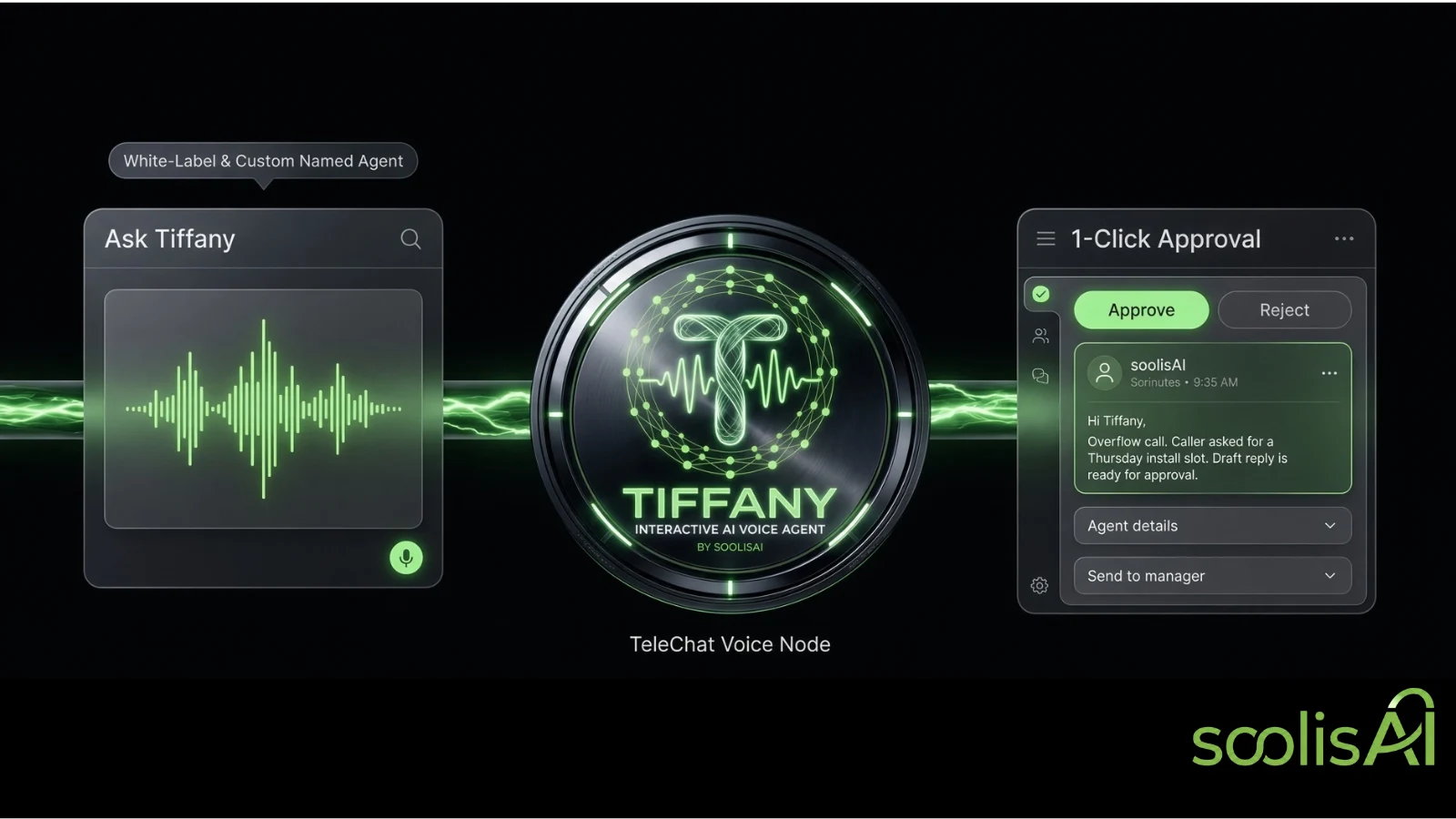
- The Human Manager "Above the Loop": Elevated above tedious manual data entry, the manager receives pre-drafted briefs and retains 1-Click Approval Authority. With a single tap, the manager reviews, edits, or approves the output, maintaining 100% brand alignment while eliminating personal career risk.
Explore live Administrative Agent Team workflows
4. Protecting Intellectual Property & Eliminating Talent Debt
For growing businesses in the 5–150 employee range, company value is tied directly to proprietary intelligence custom pricing models, client relationship histories, and specialized trade knowledge.
Deploying raw, un-governed public AI tools exposes this intellectual property to external model training set leaks. To protect company IP while keeping workforce trust high, mid-market leaders enforce two non-negotiable operational standards:
The 1st-Party Native Data Perimeter
All AI operations run 100% within a closed, private data boundary. Customer records, internal SOPs, and financial data remain strictly isolated. Your proprietary intelligence powers your internal agent teams, but never trains public third-party models.
The Skills Hub Framework
To prevent Talent Debt, organizations use a Skills Hub model to categorize operational tasks before automating:
- Bedrock Human Skills (Protect & Elevate): High-touch client negotiations, complex problem-solving and strategic account leadership.
- Acceptable Automation Skills (Streamline & Automate): Routine inbox triage, schedule confirmations, data extraction, and preliminary brief compilation.
- Risky Atrophy Skills (Monitor & Maintain): Core technical calculations where AI provides rapid drafts, but human expert review remains mandatory.
By automating administrative burden while protecting bedrock skills, personnel regain 15 to 20 hours per week to focus on high-value client execution—driving Return on Investment (ROI) directly to the P&L statement.
5. The "Start Simple" Roadmap: Capturing 3:1 ROI Without IT Payroll
You do not need an internal team of data scientists or a multi-million-dollar software budget to capture enterprise-grade AI yield. By taking a "Start Simple. Scale Where It Counts" approach, mid-market businesses capture immediate operational return through a proven 3-step deployment:
- Establish the Clean Operational Baseline (DOSS): Map and standardize your core operational workflow (Data, Operations, Systems, Structure) to identify the highest-drag administrative bottlenecks.
- Deploy Targeted Agent Teams: Introduce specialized, private agent teams to handle high-volume triage, briefing preparation, and customer communication drafting.
- Partner via Protected AI as a Service (AIaaS): Work with an embedded strategic partner like soolisAI to configure, secure, and maintain your private AI architecture—delivering a 3:1 ROI (~20% operating margin lift) with zero added technical headcount or IT payroll drag.
Stop bolting un-governed software onto broken processes. Build control into your operational architecture and scale your business with confidence.
Executive Takeaways
- Build Control Into the Architecture: Replace late-stage oversight committees with a 1st-Party Native Data Perimeter and built-in governance guardrails.
- Separate Execution from Accountability: Deploy structured Administrative Agent Teams that handle prep work while keeping human managers strictly "above the loop" with 1-click approval authority.
- Protect Intellectual Property & Avoid Talent Debt: Use the Skills Hub framework to automate routine administrative drag while elevating human judgment and safeguarding proprietary company data.
- Start Simple for Measurable Margin Yield: Achieve a 3:1 ROI and 20% operating margin lift by starting with high-impact administrative wedges through Protected AIaaS.
Sources & E-E-A-T Research Attribution
- MIT Sloan Management Review (2026): 6 Questions to Guide Your AI Strategy (McKinsey Rewiring & Systems Thinking Series). Core framework on optimal growth rates, built-in governance, demonstrable reliability, and operational ownership.
- McKinsey & Company / QuantumBlack (2026): The State of AI: On the Road to ROI. Global benchmark data detailing the enterprise vs. mid-market scaling gap, workflow redesign ratios (1:3:5 Technology : Process : Capability), and EBIT impact metrics.
- Harvard Business Review (2026): Why Your Employees Override AI (Das Narayandas, HBS). Research on career risk absorption, governance failures, and employee trust in automated workflows.
- soolisAI Executive Advisory & Platform Benchmarks (2026): Bot Teams, Not Chatbot Seats, Start Simple with DOSS, and Collaborative AIaaS Implementation Architecture.